Why AI art feels different in different cultures
Open the same image model in Los Angeles, Lagos, and Seoul and you’ll often get outputs that feel “local” in uneven ways. Part of that is taste—what readers expect from faces, color, lighting, and symbolism—but part is the tool’s defaults. Many models have learned a dominant internet aesthetic: polished, high-contrast, and broadly “cinematic,” which can flatten regional visual languages into a global style.
Cultural difference also shows up in what gets misread. A garment, gesture, or religious motif might be rendered accurately but used in the wrong context, or fused with stereotypes because similar tags co-occur online. Even when you know what you want, the cost is time: more iterations, more reference-gathering, and more careful review to keep the image from drifting into generic or culturally off-key territory.
From prompts to palettes: where culture enters the workflow
A typical AI art workflow looks neutral—type a prompt, pick a model, generate variations—but culture enters at almost every decision point. The words you choose act like a filter: “wedding,” “street market,” or “hero” carries different default imagery depending on what the model has seen, and what your language implies without stating. Reference images do the same thing more quietly. If your moodboard is pulled from global stock sites, your “local” scene may inherit global poses, lighting, and styling before you notice.
Culture also shows up after generation, in what you accept as “finished.” Palette choices, skin tones, materials, typography, and even camera distance signal genre and class. Grounding an image often requires extra steps—region-specific references, explicit negatives, and manual paintovers—because the fastest path through the tool tends to converge on familiar, widely circulated visual templates.
Training data and bias: whose visual history gets amplified
You’ve probably seen the pattern: ask for “a scientist” or “a CEO” and certain faces, outfits, and office backdrops appear more often than others. That isn’t just user bias in the prompt. It’s a training-data issue. Models learn from whatever images and captions were easiest to collect at scale, which tends to favor well-documented places, globally syndicated media, and aesthetics that are already heavily posted, tagged, and re-shared.
Visual histories with strong online footprints get reproduced as “normal,” while under-scanned archives, community-specific ceremonies, and non-Western design systems show up as distortions, hybrids, or not at all. Even when a culture is present in the data, it may be represented through tourism photos, news coverage, or costume-like depictions rather than everyday life. Correcting for this is possible, but not free: you pay in time, in careful sourcing of references, and often in the need to redraw or repaint details the model can’t reliably learn from scarce or poorly labeled examples.
Collaboration or appropriation: drawing the ethical line
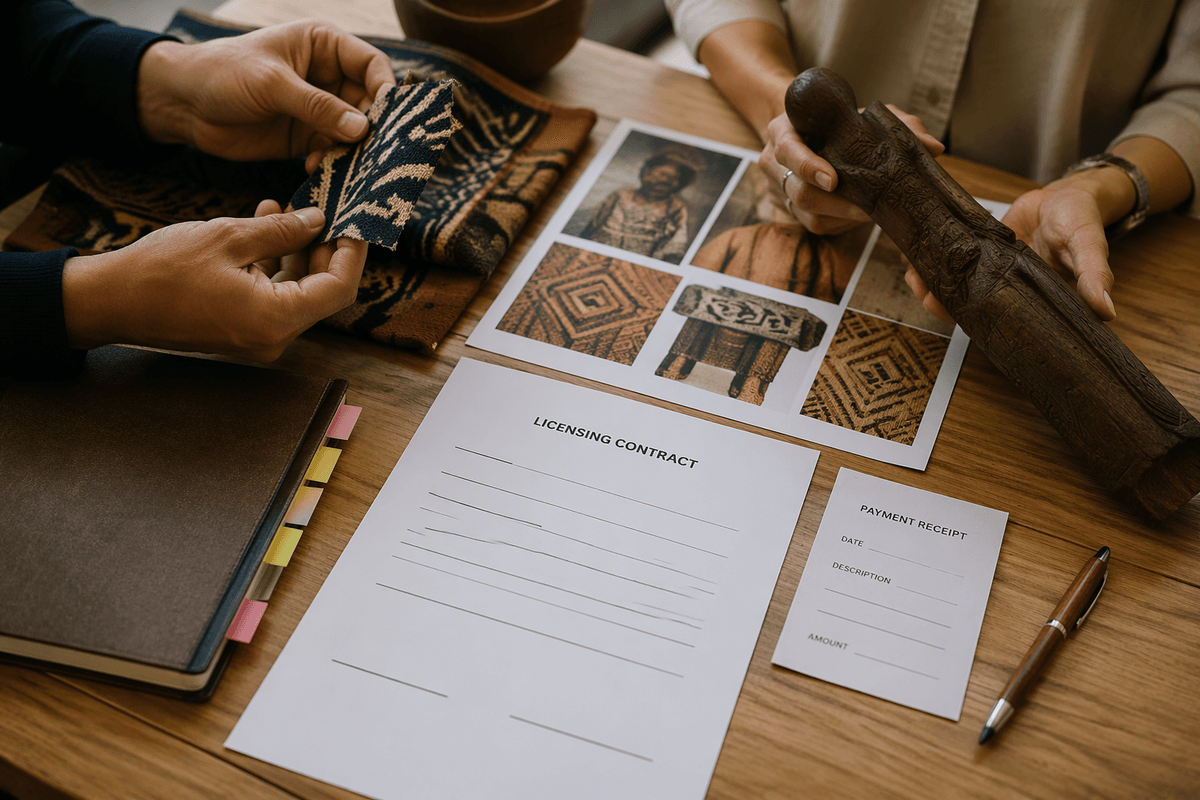
It’s easy to treat culture as a “style pack”: add a keyword, borrow a pattern, and move on. The ethical line shows up when the work relies on recognizable motifs, sacred symbols, or community-specific design systems without context, permission, or benefit flowing back. A collaborative approach looks different in practice: you involve cultural holders early, ask what should be avoided or credited, and let feedback change the image rather than just “polish” it. You also keep track of where references came from, because “I found it online” often means someone else’s labor, ceremony, or identity became raw material.
AI adds a specific complication: the model can output plausible-looking details that are wrong in ways a non-expert won’t catch. That raises the bar for review and compensation. Paying a consultant, licensing reference material, or sharing revenue can feel like friction against a fast workflow, but it’s often the cost of keeping cultural specificity from turning into extractive decoration.
Language matters: prompting across dialects, scripts, and slang
You can watch language steer the image before you touch any “style” setting. Write “bodega” and you may get a New York corner store; write the equivalent term in Caribbean Spanish and the scene can drift toward a tourist-market cliché, because the model’s caption data links words to different photo pools. Dialect and slang add another layer: a phrase that feels precise to you may be rare in the training set, so the model backs off to safer, more common associations.
Scripts matter too. Prompts in Arabic, Devanagari, Hangul, or mixed romanization can change which concepts the model recognizes, and whether it treats text as meaning or decoration. A practical workflow is to iterate in two passes: first in the community’s language for concepts and objects, then in a “translation” prompt that lists concrete visual constraints. The cost is extra time and occasional misfires from imperfect translation.
Practical patterns for culturally grounded AI digital art
You’ll recognize the moment an image “works” technically but feels culturally unmoored: the clothes are close, the setting is plausible, yet the scene reads like a generic global ad. A grounded workflow usually starts with constraints, not adjectives. Build a small reference set from region-specific sources (local photographers, museum collections, community archives, packaging, signage), then translate those into a checklist: materials, silhouettes, color logic, climate cues, and what must not appear.
Generate in layers. First pass for composition and lighting; second pass for culturally specific objects; then manual edits for the details models routinely mangle—text, jewelry, ritual items, and hand gestures. Keep a “negative list” of shortcuts the model keeps reintroducing (tourist costumes, stock-photo poses, mismatched religious symbols). The better references cost money or permissions, and the more specific you get, the more you’ll rely on paintovers and human review to keep specificity from collapsing into stereotype.
Rights, credit, and compensation in cross-cultural AI art

A client wants “inspired by” a living tradition, and the model can produce something close enough to feel authentic while still being untraceable. That’s where rights questions get slippery: copyright may not cover a community motif, but cultural authority and moral rights still matter to the people who carry it. Treating the output as “original” because it’s synthetic is a legal shortcut that can still be ethically extractive.
A workable baseline is to separate credit from ownership. Credit the human sources you can name: the local artist you consulted, the archive you licensed, the photographer whose reference shaped the scene, the language help that made the prompt accurate. Then address compensation as a budget line, not a courtesy—consulting fees, reference licenses, revenue share, or commissioning a collaborator to create the culturally specific elements. The constraint is practical: tracking sources slows fast iterations, but it’s often the only way to keep cross-cultural work defensible when it circulates commercially.
A future where tools are global and stories stay local
You can already feel the tension: the same models, presets, and “cinematic” defaults are everywhere, but audiences still read meaning through local cues—what a neighborhood looks like, how grief is shown, what counts as beauty, what symbols are off-limits. The practical question isn’t whether tools will globalize; they already have. It’s whether creators will keep doing the slower work that keeps images from converging.
A useful operating principle is to treat AI as a universal engine and cultural specificity as a layer you author, verify, and pay for. That means budgeting for local reference licensing, language support, and expert review, and building feedback loops with the people whose visual logic you’re borrowing. These steps add time and cost, but they’re also how “global tools” stop producing interchangeable stories.