Why ML feels magical—and where it reliably breaks
You’ve seen the demo: a model tags photos, flags fraud, or predicts churn with a few lines of code. It feels magical because it turns messy signals into a usable score without spelling out rules. But that “magic” is mostly pattern matching under specific conditions—similar inputs, stable definitions, and feedback that reflects the real outcome you care about.
It reliably breaks when those conditions slip. If the training data quietly bakes in outdated behavior, the model will look accurate in testing and fail in production. If you can’t clearly define success, the model optimizes a proxy and surprises you. Even when it works, it brings costs: data pipelines, monitoring, retraining, and time spent investigating edge cases you didn’t know mattered.
The first limit: your goal is fuzzy or poorly measured

A familiar failure mode is when the team says, “Predict customer satisfaction,” but the only label available is a post-call survey that 3% of users complete. The model can only learn what you can measure, so it will optimize for the quirks of that survey population, not for satisfaction broadly. You’ll get a clean-looking metric and a messy business outcome.
Even “objective” targets can be fuzzy in practice. Fraud becomes “fraud we caught,” quality becomes “tickets created,” and hiring success becomes “manager ratings after 90 days.” Those are proxies shaped by process, incentives, and who bothers to report problems. When the goal is ambiguous, different stakeholders silently mean different things, and the model becomes an expensive way to formalize the wrong definition.
Sharpening the target often costs more than training the model: instrumenting events, revising workflows, running audits, and accepting delays while labels mature. If you can’t tighten the definition, treat ML outputs as decision support, not automation.
Data isn’t just “more”: coverage, bias, and leakage
A common reaction to weak model performance is “we need more data,” but the real question is whether you have the right coverage. If your churn model mostly sees long-tenured users, it will look confident and then stumble on new signups because their early behavior looks nothing like the training set. If you’re scoring support tickets, but only certain teams tag issues consistently, the model learns the tagging habits, not the underlying problem types.
Bias often enters through what gets recorded, not just who is in the dataset. Collections data reflects who you were willing to contact, medical data reflects who could access care, and moderation data reflects what users bother to report. Those gaps can produce systematic errors that feel “unfair” even when the model is statistically consistent with the logs you gave it.
Leakage is the quieter trap: training on signals that won’t exist at decision time, like using a “refund processed” field to predict refunds. It boosts offline accuracy, then collapses in production. Preventing it takes discipline and cost: time-based splits, feature reviews, and periodic audits of the pipeline, not just another training run.
Generalization fails when the world changes underneath you
You launch a model and it performs well for a month, then the business changes and the score quietly loses meaning. Marketing tweaks pricing, a competitor runs a promotion, a new product flow shifts user behavior, or a policy update changes what “fraud” looks like. The model hasn’t gotten worse at learning patterns; it’s just seeing a different world than the one it was trained on.
This shows up as distribution shift: the inputs drift (new device types, new traffic sources), the relationship between inputs and outcomes shifts (a feature no longer predicts churn), or the labels shift (support teams reclassify tickets, changing what “high severity” means). Offline tests can still look fine if they resemble old data, so teams over-trust dashboards while users experience odd decisions at the edges.
You need monitoring for drift and business KPIs, holdout slices for new segments, and a retraining plan tied to product changes—not just a calendar. Sometimes the right answer is to freeze automation, route uncertain cases to humans, and treat the model as a moving dependency, not a one-time deliverable.
Trade-offs you can’t avoid: accuracy vs speed vs cost
A familiar moment is when the model “works,” but only if you let it be slow and expensive. A real-time fraud check might need an answer in under 100 ms, but the most accurate approach may rely on heavy feature joins, multiple models, or a large neural network. If you can’t fetch fresh signals that quickly, you either accept a weaker model, precompute features (and risk staleness), or move the decision later in the flow.
Accuracy also has a price in operations. Higher lift often comes from more data sources, more complex pipelines, and more frequent retraining. Each adds cloud spend, engineering time, and more things that can break at 2 a.m. Vendors can hide this by quoting an offline metric, while you pay the ongoing inference, storage, and monitoring bills.
The useful question is not “what’s the best model?” but “what level of error is tolerable at this latency and budget?” Decide where speed and cost are fixed constraints, then treat model complexity as a tool—not a trophy.
When errors aren’t equal: risk, fairness, and explainability
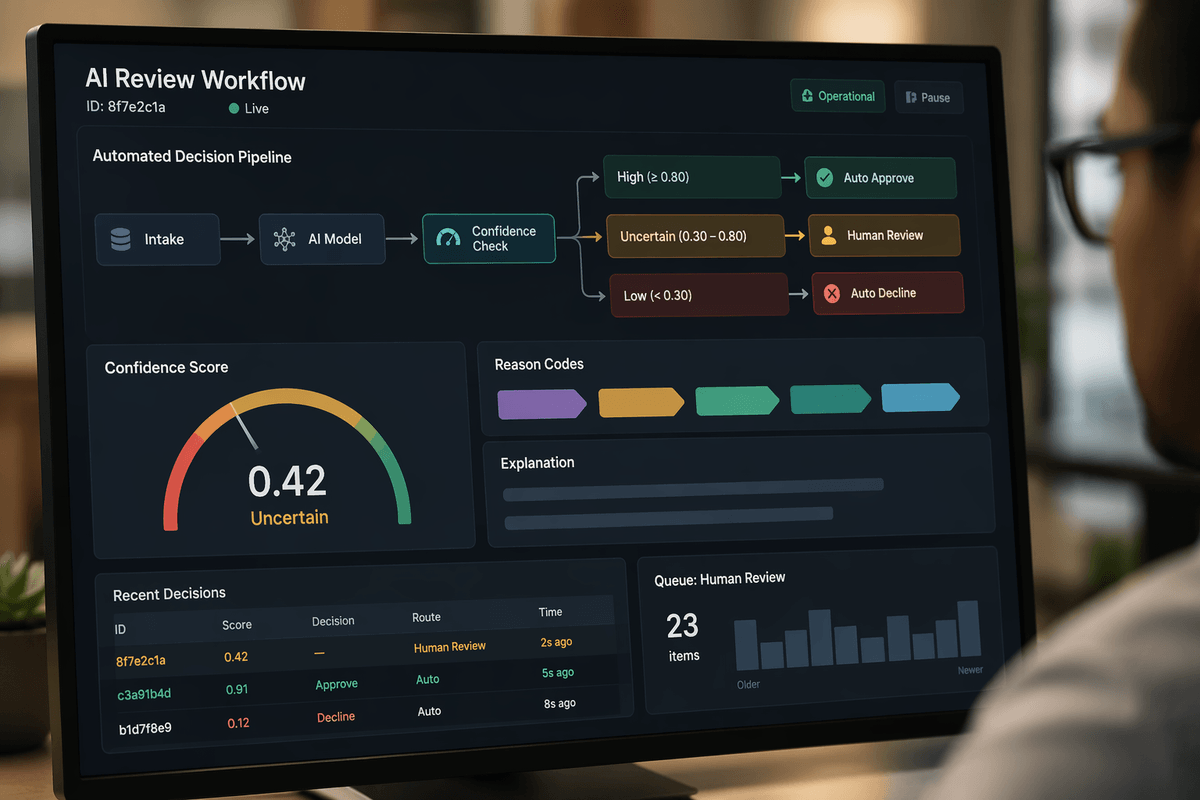
A support triage model that misroutes one low-priority ticket is annoying; a lending model that wrongly declines a qualified applicant is costly and reputationally risky. Treating both as “1% error” hides what matters: which direction the error goes, who bears the downside, and how recoverable it is. Start by separating false positives from false negatives, then map each to a concrete harm, escalation path, and acceptable rate. If the harm is asymmetric, the threshold should be too.
Fairness issues often appear as uneven error rates across groups or contexts, even when overall accuracy looks strong. The practical difficulty is that you may not have clean demographic labels, and collecting them can raise legal and privacy constraints. You can still test slices you do have—region, device type, tenure, acquisition channel—and watch for consistent gaps that suggest the model is learning convenience signals rather than the underlying intent.
Explainability is less about a perfect story for every prediction and more about operational control: can you justify decisions to users, regulators, and internal reviewers, and can you debug failures quickly? Complex models can be fine, but only if you invest in review workflows, reason codes that are stable, and “I don’t know” routing when confidence is low.
A practical checklist to decide: ML, rules, or neither
The familiar fork is whether you need a learned score at all. Start with four checks: can you write down the decision rule today, and would stakeholders agree on it? Can you define a label that matches the real outcome, and will you still have it at decision time (no leakage)? Do you have coverage for the segments you’ll ship to, not just the ones easiest to measure? Can you monitor drift and harm, with an owner and budget for fixes?
If the rule is stable and auditable, use rules. If patterns are complex but measurable and maintainable, use ML with guardrails (thresholds, “unknown” routing, human review). If you can’t define success or collect dependable data, don’t automate yet—instrument first.