When the overall WER looks fine but complaints cluster
The dashboard says your speech-to-text model is “good enough,” yet the same kind of complaint keeps showing up: callers with a particular accent are asked to repeat themselves, agents fix the same words by hand, or certain names are consistently mangled. That pattern can hide inside a healthy overall WER because the average is dominated by the largest, easiest slices of traffic. If 90% of your audio is clean and homogeneous, it can mask a much worse experience for the remaining 10%.
The hard part is that “bias” isn’t a single number you can read off a report. You have to decide what unfairness looks like for your product: higher error rates for certain speakers, more harmful substitutions (like changing “not” to “now”), or longer correction time in downstream workflows. Labels may be missing, sample sizes may be tiny, and customer reports can be vague. The next step is to make that definition concrete enough to test.
What do you actually mean by “bias” for this product?

Making it concrete enough to test usually starts with a moment your team recognizes: a manager says, “These calls are harder,” but your report only shows one overall WER. For this product, “bias” has to map to an outcome you can measure and a user impact you care about. Otherwise you’ll argue about philosophy while shipping the same blind spot.
A practical definition often falls into one (or more) buckets: (1) higher error rates for some speakers (gap in WER/CER), (2) different kinds of errors that carry more risk (negations, numbers, medication names, legal terms), or (3) unequal downstream cost (more agent edits, longer handle time, higher abandon rate after a “please repeat” prompt). If your product gates access—voice authentication, IVR navigation—then “bias” may mean different false reject rates by speaker group, not just transcription accuracy.
The constraint is that you can’t optimize what you can’t label. If you lack reliable demographics, you may need to define groups through what you can observe (region, channel, language ID confidence) and accept that the results won’t generalize cleanly. That forces the next decision: which speaker groups you’ll treat as “must-cover” without boxing yourself into a taxonomy you can’t maintain.
Picking speaker groups without painting yourself into a corner
In practice, a team starts by grabbing the labels they already have—“US vs. non-US,” “male vs. female,” “native vs. non-native”—and then realizes those buckets don’t match how complaints show up in real calls. If you lock into a rigid taxonomy too early, you either exclude the very speakers you need to learn about or you create categories you can’t populate, refresh, or defend later.
Pick groups the same way you pick product requirements: start from credible risk. If your support org flags Caribbean English callers, make that a must-cover slice. If your IVR runs on mobile in noisy environments, cut by channel and SNR, not just demographics. When demographics are missing, use proxies you can measure (locale, device class, region, language-ID confidence), and write down what each proxy fails to capture.
The real constraint is sample size. A “long tail” of tiny groups will produce unstable gap estimates and endless debates. Start with a small set of high-impact slices, then add finer splits only when you can consistently collect enough audio and ground truth to keep them meaningful.
Your test set won’t be neutral—so design it on purpose
Once you commit to a small set of must-cover slices, the usual move is to “just sample some calls” and call it a test set. That almost always bakes in the same imbalance you saw in production: the easiest audio dominates, and the rare but high-impact cases barely appear. If you then report one gap number, you’re mostly measuring your sampling policy, not the model.
Design the set around the failures you can’t afford. Start with a coverage table (slice × scenario) and assign minimum counts: e.g., each speaker slice gets clean vs. noisy, headset vs. speakerphone, and at least one “hard vocabulary” bucket like names, addresses, or numbers. If your product uses VAD, diarization, or endpointing, include clips where those components struggle (interruptions, crosstalk, short turns), because “bias” often shows up as pipeline breakage, not just substitutions.
The constraint is cost. Balanced sets require more human transcription on long-tail audio, and you’ll still miss edges you didn’t imagine. Decide up front which scenarios you’ll treat as out of scope today—and which ones you’ll add to continuous sampling once you ship.
Beyond one WER: metrics and cutdowns that surface uneven errors
That “coverage table” only pays off if your reporting can actually reveal where things go wrong. A single WER per slice is a start, but it often hides the pattern that users feel: one group gets hit by a few high-impact errors while another group gets lots of harmless ones. So keep WER, then add cutdowns that match your product’s pain points.
Common additions are simple: separate deletion, insertion, and substitution rates; track a character error rate (CER) for names and spellings; and report “sentence error rate” (the share of utterances with any error) for short commands, where one mistake ruins the turn. If your workflow cares about entities, score numbers, dates, amounts, addresses, and proper nouns as their own buckets. A tiny WER change that doubles number mistakes is not “tiny” for billing or logistics.
Also cut by scenario, not just speaker group: SNR bands, channel, overlap/crosstalk, turn length, and “hard vocabulary” prompts. The catch is annotation overhead—entity tagging and scenario labels cost time, and inconsistent tagging will create fake gaps. Start with two or three buckets you can label reliably, then expand once the process is stable.
Small groups, noisy estimates: making comparisons you can defend
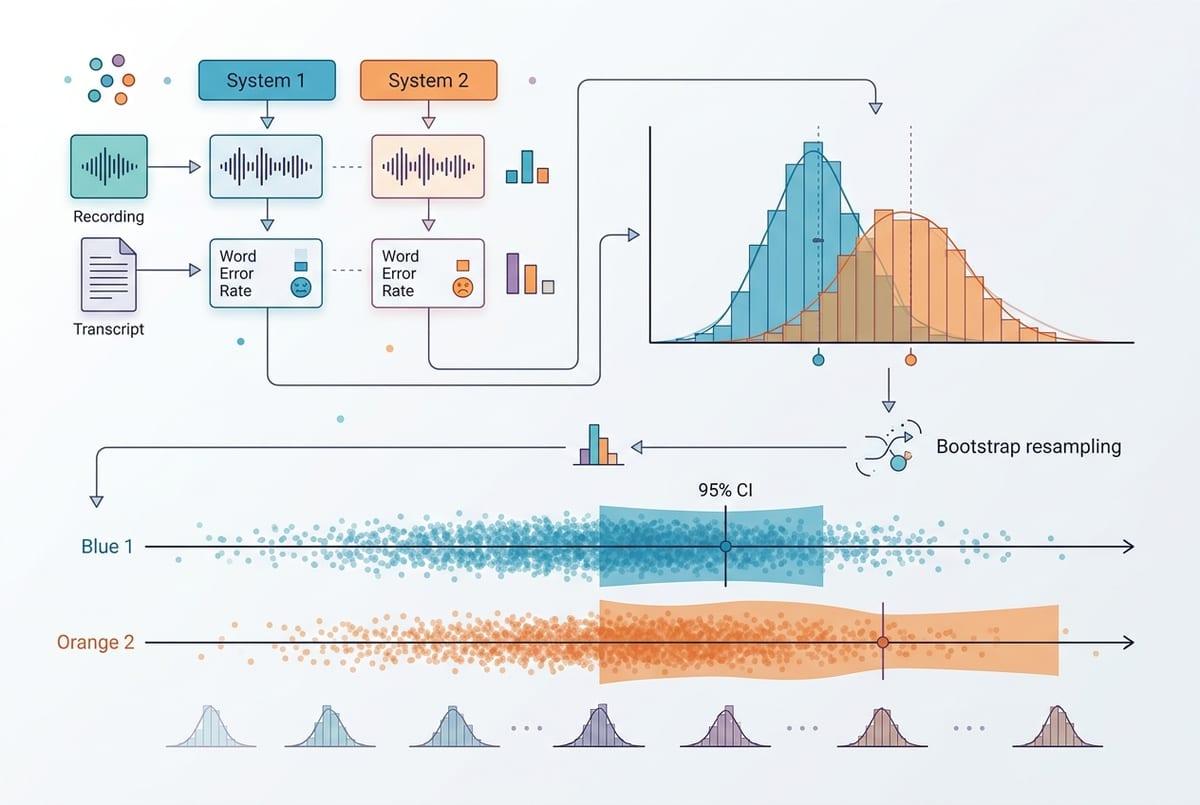
Once you expand beyond a couple reliably labeled buckets, you hit the same wall almost every team hits: the slice you care about has 40 utterances, not 4,000. Then a 3-point WER gap might be real, or it might be two bad calls with crosstalk and a weird address. If you treat every tiny slice number as “the truth,” you’ll either overreact or freeze.
Start by reporting uncertainty, not just point estimates. Use paired comparisons when you can (the same utterances scored on both systems), and summarize gaps with bootstrap confidence intervals so you can say “likely better,” “likely worse,” or “too close to call.” Also set minimums: don’t rank vendors on a slice unless it has enough words and enough speakers to avoid one person dominating the result. If you can’t meet that bar, aggregate related slices and keep the raw counts visible.
The real difficulty is cost and time: more audio and better labels are often the only fix for noisy gaps. That’s why the next step is being explicit about what you tested, what you didn’t, and what you’ll monitor after launch.
What you document, what you monitor, and what you fix first
After launch, the same complaint can mean three different problems: the slice is under-covered in your test set, the model fails on a specific scenario (like crosstalk), or your labels are too noisy to trust the gap. So document the evaluation like a release artifact: slice definitions (and proxies), counts of speakers/words, scenario cuts, scoring rules, and the slices you intentionally didn’t cover. Put the “unknowns” in writing, not in someone’s memory.
Then monitor what users feel, not just WER: edit rate in your UI, repeat prompts, entity error rates for numbers/names, and drift in slice mix (new regions, new devices). Fix first where impact and confidence overlap: large, consistent gaps on high-volume flows, or small gaps on high-risk entities. Everything else becomes a data-collection plan with dates and owners.