Why labeled data is the bottleneck again
A product team can have months of logs, tickets, chats, images, or sensor streams and still be blocked on the same question: “What do we actually train on?” Labeled datasets turn messy reality into something a model can learn from, but creating them is slow, expensive, and operationally awkward. The bottleneck isn’t just paying annotators; it’s defining labels that match the business goal, writing guidelines that different people interpret consistently, and handling edge cases that never stop showing up.
Modern systems make this harder, not easier. Products change, policies shift, and user behavior drifts, so labels decay and must be refreshed. Many high-value domains add constraints: privacy rules, regulated content, and internal access controls limit who can label what and where it can be stored. Even when you can label, you often discover the long tail—rare but critical situations—costs disproportionately more per useful example than the “easy” majority cases.
That’s why unlabeled data is tempting again: it’s abundant, cheap to collect, and closer to real deployment conditions. The catch is that unlabeled volume doesn’t automatically become training signal; without careful methods, you can scale noise, bake in bias, or optimize for what’s frequent rather than what matters. Label-free learning is best understood as a way to convert raw data into supervision-like structure, not a way to avoid thinking about what “good” means.
What “label-free learning” really includes (and excludes)
A familiar pattern is calling anything trained on logs “label-free,” then being surprised when results stall. In practice, label-free learning is a bundle of techniques that manufacture training signal without manual, per-item labels. Self-supervised learning uses the data itself as the target (predict a masked word, the next frame, or whether two views came from the same item). Weak supervision uses imperfect rules, heuristics, metadata, or distant labels (a button click, a URL category, a templated ticket field) as noisy targets. Distillation transfers behavior from a larger or proprietary model into a smaller one using generated outputs as pseudo-labels.
What it excludes is “no supervision at all.” Someone still chooses objectives, data filters, and what counts as a positive or negative pair—decisions that encode product assumptions. It also doesn’t remove compliance work: using raw chat logs may be cheaper than labeling them, but retaining, processing, and auditing them can be the real cost.
When label-free beats labeling—and when it doesn’t
The common place label-free wins is when you need broad coverage before you know the final taxonomy. If your support tickets, call transcripts, or product events shift every quarter, pretraining or weak supervision can absorb new phrasing and behaviors without rewriting labeling guidelines. It also shines when “similarity” is the real product primitive—search, deduplication, recommendations, clustering—because contrastive or embedding-focused training can turn raw co-occurrence (same session, same thread, same device) into useful structure at scale.
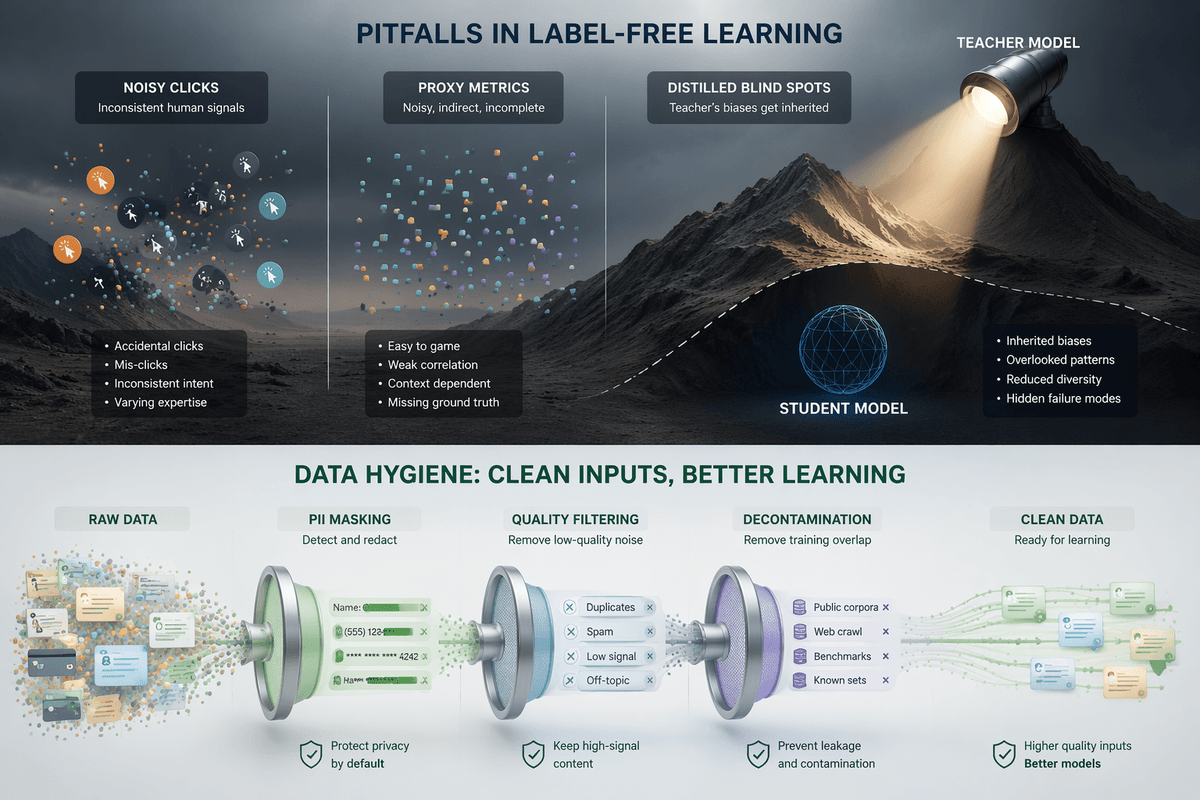
It loses when the business definition is narrow, high-stakes, or counterfactual. Fraud, safety, medical triage, and compliance often depend on rare edge cases and precise boundaries that logs don’t express. Clicks and downstream actions are noisy proxies, and distillation can quietly copy the teacher’s blind spots. The practical constraint is operational: label-free approaches usually demand more data hygiene (PII handling, filtering, decontamination) and more careful evaluation, because improvements can look real on proxy metrics while missing the cases that matter.
Choosing an approach: pretrain, contrast, distill, or embed
A team choosing a label-free approach is usually deciding what kind of “structure” they can reliably extract from what they already have. If your data is mostly raw text, images, or audio and you need general robustness to new wording or formats, pretraining (self-supervised) is the broadest bet. It won’t line up to your KPIs by itself, but it can make later fine-tuning far more data-efficient and resilient to drift.
If the product is driven by “what’s similar to this?”—search, matching, deduping, routing, retrieval—contrastive learning or direct embedding training often gets you to usable behavior faster. Your positives/negatives must be defensible (same session, same thread, same account) or you’ll teach the model superficial cues. Distillation fits when a large model already performs the task acceptably and you need cost, latency, or on-prem control; the risk is inheriting the teacher’s bias and errors. When in doubt, start by building embeddings for retrieval and measurement, then decide whether you truly need an end-to-end classifier.
Turning raw data into usable training signal safely

A familiar failure mode is treating “we have lots of logs” as equivalent to “we have lots of training data.” Raw data is full of identifiers, repeated templates, monitoring noise, and feedback loops (for example, the model’s own prior suggestions showing up in future tickets). Before you generate pseudo-labels or pairs, teams usually need a hard-nosed data pass: remove direct PII, deduplicate near-copies, separate time periods to avoid leaking “future” behavior into training, and define what sources are in-bounds for retention and audit.
Once the data is safe to touch, the training signal should be conservative. Use high-precision heuristics first (strong metadata, explicit user actions, unambiguous system states), then expand coverage gradually while measuring how much noise you’re adding. Build “don’t learn from this” filters as first-class artifacts: low-confidence model outputs, policy-flagged content, rare but sensitive categories, and anything that looks like evaluation data. The practical cost is real: strong filtering reduces volume, and setting up logging, lineage, and review workflows can take longer than an initial labeling sprint, but it prevents quietly scaling the wrong behavior.
Mixing label-free learning with small, strategic labels
The product team rarely has to choose between “all labels” and “no labels.” The leverage move is using a small amount of human labeling to anchor a much larger label-free pipeline. For example, you can pretrain or learn embeddings on all tickets and chats, then label a few hundred carefully sampled items to define the exact boundary you care about (escalate vs. route, safe vs. unsafe, refund-eligible vs. not). Those labels become a calibration set: they tell you which clusters are real, which heuristics are misleading, and where pseudo-labels need tightening.
The sampling strategy matters more than the count. Don’t just label random data; label the uncertain band (where the model is least confident), the high-impact cases (expensive mistakes), and the long tail (rare but policy-critical scenarios). Use those labels to validate weak rules, tune thresholds, and retrain periodically as drift shows up. The constraint is operational: this requires an active learning loop, review capacity, and clear labeling guidance, or the “small labels” become inconsistent and stop correcting the noise.
Measuring progress without fooling yourself
A team will often see proxy metrics improve quickly once it starts pretraining, distilling, or generating pseudo-labels—and then discover that the product experience didn’t move. The usual cause is evaluating on the same kind of signal used for training: clicks predict clicks, teacher outputs match teacher outputs, heuristics validate heuristics. If the “ground truth” is partly your own pipeline, you can measure consistency without measuring correctness.
The practical fix is separating three things that tend to get blended: representation quality, task performance, and business impact. Use retrieval-style checks (nearest-neighbor sanity tests, cluster coherence, duplicate detection) to judge embeddings. Use a small, stable human-labeled set—kept out of any pseudo-label generation—to measure the decision boundary you actually care about. Then connect that to an online metric with guardrails (holdouts, time-based splits, and segmented reporting for rare but costly cases), because averages will hide regressions in the tail.
Maintaining a “gold” evaluation set costs time, requires adjudication when labelers disagree, and becomes stale as policies change. That cost is still lower than shipping a confident-looking model that improved only on the data it taught itself to predict.
A practical adoption path for expanding training data fast
A practical rollout usually starts with an inventory, not a model. Identify which raw sources you can legally retain and replay (with lineage), then build a conservative “clean room” dataset: deduped, time-sliced, and stripped of direct identifiers. Train embeddings or a self-supervised backbone first so you can search, cluster, and spot obvious gaps before committing to a task head.
Then add training signal in layers: high-precision weak labels (explicit user actions, unambiguous system states), followed by distillation or broader heuristics once you’ve seen failure modes. Keep a small, stable human-labeled set as the gate for every expansion, and label only where it buys down risk: the uncertain band, high-cost mistakes, and policy-sensitive tail cases. The main constraint is operational: logging, filtering, and review workflows must be treated like product infrastructure, or the pipeline will silently drift.