The real question: where does collaboration still win?
Most teams aren’t struggling to “use AI.” They’re struggling to decide when a second mind—human or machine—actually changes the outcome. If the work is mostly retrieval, formatting, or first-pass drafting, collaboration often just adds meetings and latency. If the work depends on shared context, trade-offs, and responsibility, collaboration still wins because it reduces blind spots and makes decisions defensible.
A useful way to judge it is to ask: would a reasonable person disagree about what “good” looks like here? When the answer is no, let the assistant run and review lightly. When the answer is yes—because priorities conflict, the audience is sensitive, or the cost of being wrong is high—bring in a teammate early, even if it slows you down.
Tasks AI can do alone versus tasks needing people

You’ve seen the pattern: some work is “produce something plausible,” and some work is “choose something defensible.” AI can often run solo on bounded tasks where the inputs are clear and the output can be checked quickly. Think: reformatting notes into a template, drafting a neutral FAQ from existing policy, summarizing a call, generating test cases from a spec, writing SQL from a well-defined question, or creating variants of ad copy when the audience and constraints are already decided.
People are still needed when the task relies on tacit context or carries consequences the assistant can’t own. Anything involving strategy, prioritization, commitments, sensitive relationships, or ambiguous requirements should trigger collaboration: setting pricing, responding to an escalated customer, approving a security exception, defining success metrics, writing performance feedback, or making a product trade-off. The practical cost is review time and coordination, but it’s usually cheaper than unwinding a confident-sounding mistake that shipped without a human decision-maker attached.
Red flags that require human judgment and context
You notice the riskier moments because the assistant stops acting like a tool and starts acting like a decider: it makes assumptions to fill gaps, picks winners among competing goals, or proposes a “best” answer without showing the trade-offs. Treat that as a red flag any time the work touches commitments (dates, pricing, scope), reputational impact (public statements, executive comms, sensitive customers), or irreversible actions (sending notices, changing configs, closing accounts). If the right outcome depends on local norms—how your company phrases apologies, what Legal usually rejects, what Support can actually offer—pull in someone who holds that context.
Another red flag is when you can’t state the evaluation criteria in one sentence. If “good” depends on politics, risk tolerance, or what you promised last quarter, the assistant can draft options, but a human should choose. Watch for missing constraints: unstated dependencies, data access limitations, policy exceptions, or edge cases the model glosses over. The cost is slower throughput, but it’s predictable; cleanup after a wrong call rarely is.
Where collaboration improves results most: explore, decide, deliver

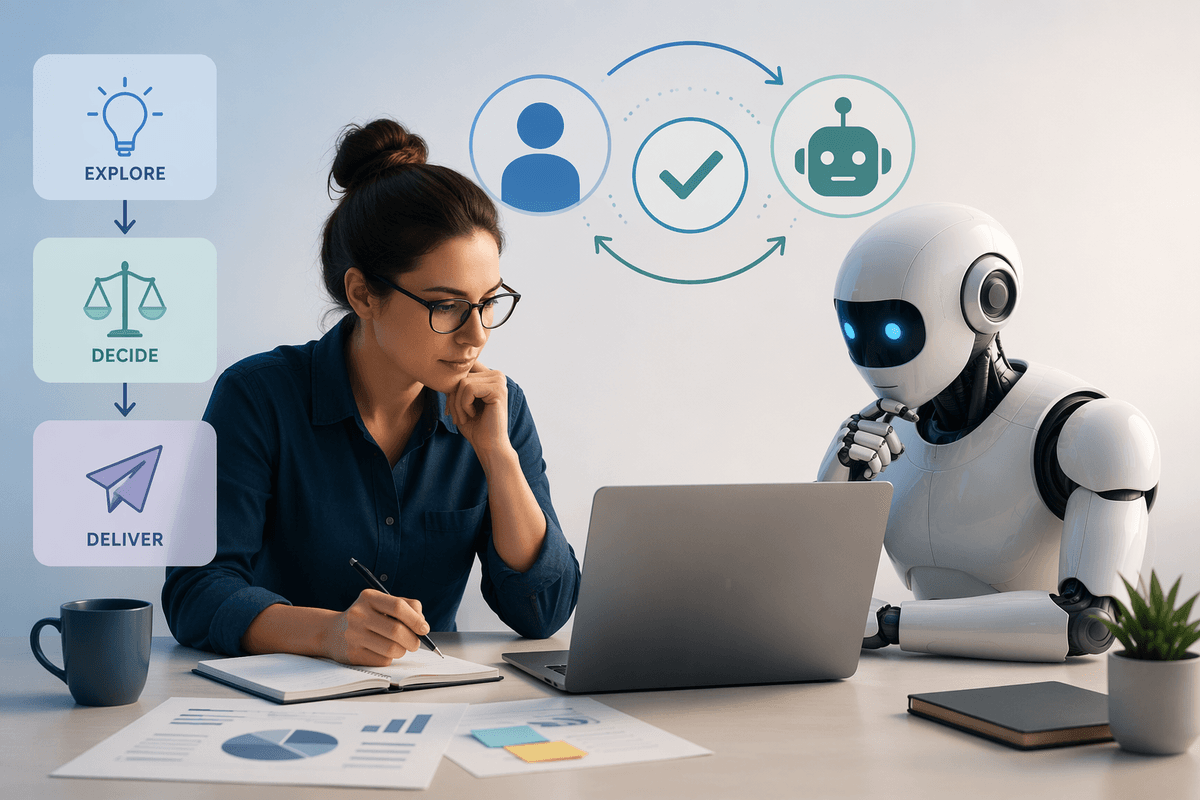
A common failure mode is using AI as a solo worker across an entire project, when the work actually moves through three modes: explore, decide, deliver. In explore mode, collaboration improves breadth. Let the assistant generate hypotheses, alternatives, and questions, then have a teammate add the “we tried that” history, customer nuance, and constraints the model can’t see. The output you want is a short menu of options with unknowns attached, not a single “answer.”
In decide mode, collaboration improves defensibility. Put a human owner on the call and use the assistant to stress-test: summarize trade-offs, surface second-order effects, and draft a decision record with assumptions. This is where teams save the most pain, because a crisp decision plus rationale prevents re-litigation later.
In deliver mode, collaboration improves consistency. AI can draft, format, and produce variants quickly, while humans review for tone, policy, and edge cases before anything ships. The constraint is coordination overhead; keep the handoffs explicit so “helpful” rewrites don’t silently change intent.
Collaboration patterns that boost quality without slowing teams
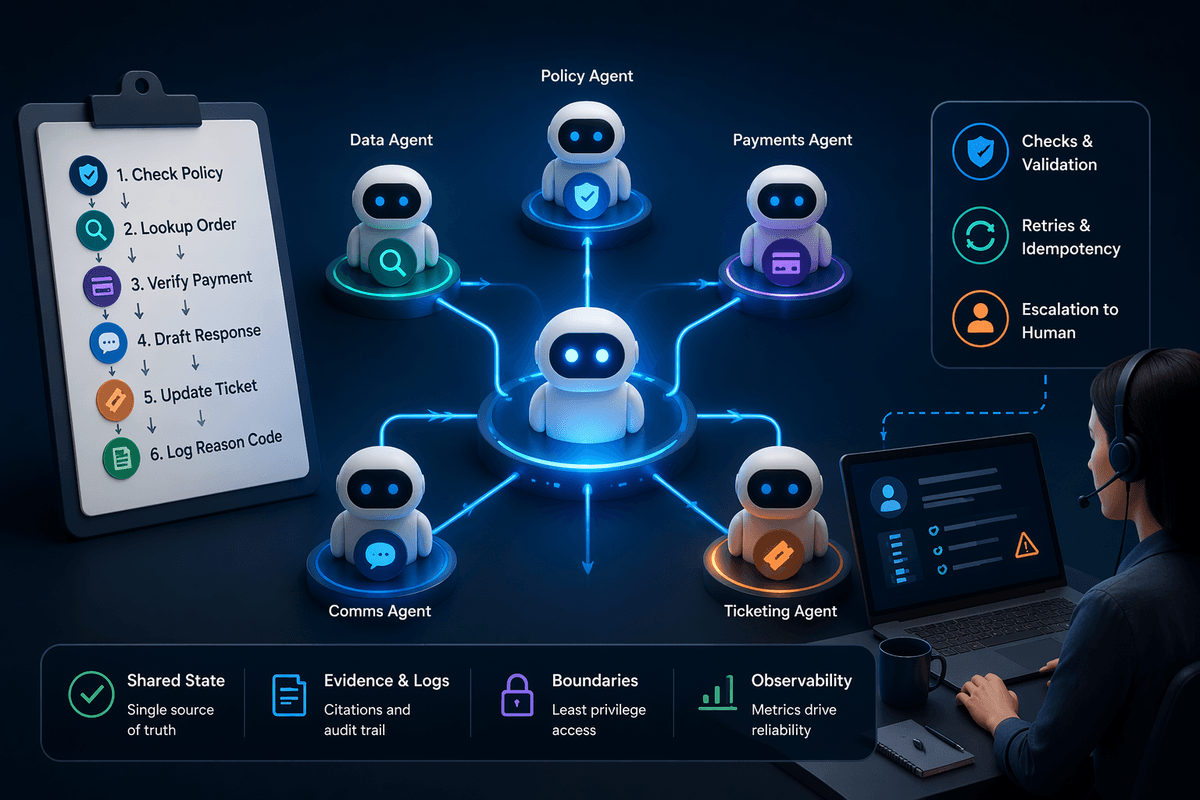
You can keep collaboration lightweight by making it event-driven instead of meeting-driven. Use “review on trigger” rules: only pull in a teammate when the assistant touches commitments (dates, scope, pricing), external messaging, policy boundaries, or anything that can’t be undone. Everything else runs as a two-step loop: the assistant produces a draft plus a short “assumptions and open questions” block, and the human reviewer only validates those items rather than re-reading the whole artifact.
Speed also improves when roles are explicit. One person owns the decision, the assistant generates options and wording, and a second human acts as a spot-checker for risk and context. Keep reviews time-boxed (for example, 10 minutes to approve, edit, or escalate) and require diffs when the assistant rewrites, so intent doesn’t drift. The trade-off is upfront setup—templates, checklists, and escalation rules take time to design—but they pay back by reducing back-and-forth and preventing slow, unstructured “just to be safe” reviews.
Guardrails: privacy, accountability, and when not to delegate
The tension shows up almost immediately in real-world use. The quickest route to a useful answer is often to paste the full context into an AI assistant. The safer route is usually more deliberate. Framing the issue as a workflow problem rather than a personal judgment call leads to better decisions: sensitive information should be filtered out by design, not only by memory or caution in the moment.
A practical starting point is to treat personally identifiable information, customer records, contract details, credentials, security incidents, and unreleased financial data as redaction defaults. When a task genuinely requires that level of detail, the better solution is usually an approved internal system with access controls, audit logging, and retrieval mechanisms built around existing permissions. That approach introduces friction and adds setup time, but it also reduces the chance that a convenient shortcut becomes a compliance problem later. Human accountability remains essential regardless of how much work an assistant performs. External communications, system changes, policy decisions, and other consequential actions should always have a clearly identified owner. Maintaining a lightweight record of inputs, sources, generated outputs, and verification steps creates transparency without turning every interaction into a bureaucratic exercise.
Some decisions are poor candidates for delegation in the first place. Irreversible actions, regulated processes, sensitive personnel matters, public commitments, and legal or medical judgments still require human responsibility at the point of decision. In those situations, AI is most valuable as a tool for drafting alternatives, organizing information, and highlighting considerations—not as the final authority on what happens next.
How to tell if human-in-the-loop is actually working
You can tell it’s working when review becomes faster and narrower over time. Track a few signals: how often humans change the assistant’s “facts and commitments” versus just polishing wording, how many outputs get escalated on trigger rules, and how many downstream fixes appear after shipping (reopened tickets, reverted changes, follow-up clarifications). If the same error repeats, your loop is decorative, not corrective.
Also watch for hidden costs. If people are re-reading everything end-to-end, you built a second drafting layer, not leverage.
A healthy pattern is predictable: the assistant drafts, the human verifies the assumptions, and the artifact ships with a named owner.