Why long-horizon decisions break simple automation
Most business automation works when each step can be decided in isolation: approve a shipment, reorder a SKU, assign a shift. Long-horizon problems don’t behave that way. A small choice today—expedite one lane, pull forward a promotion, delay maintenance—changes the options and costs available weeks from now, often through capacity limits, contracts, and knock-on inventory effects. Simple rules and one-step predictive models tend to chase local wins, then “pay for it later” in stockouts, overtime, or service penalties.
The difficulty is that the best action depends on sequences, not points. You need to compare plans that trade off near-term pain for downstream stability, and you need to do it under constraints that are easy to state but hard to satisfy at scale (lead times, minimum order quantities, labor rules, vehicle routing, fairness policies). Even when a heuristic works in normal conditions, it can fail abruptly under demand spikes or supply disruptions because it has no mechanism to reconsider earlier commitments.
Long horizons also expose a practical cost: the number of possible futures grows faster than teams can test by hand. Simulation spreadsheets become slow and fragile, and “set-and-forget” automation becomes risky because drift is inevitable—carriers change performance, suppliers miss dates, and pricing response shifts. That’s the gap AI planning systems aim to fill: not better guesses of the next step, but better decisions across many steps, with explicit trade-offs and a way to adapt when reality doesn’t match the plan.
What an AI planning system actually does
A planning system sits between prediction and execution. It takes an objective you care about (cost, margin, service level, throughput) and searches for a sequence of actions that performs well over a horizon, while obeying constraints like capacity, labor rules, minimum order quantities, and promised delivery dates. Instead of outputting “demand will be 1,200,” it outputs “place this order now, move this inventory, assign these shifts, route these stops,” because those choices are what change outcomes.
To do that, it needs a way to score candidate plans. That score usually comes from a world model: a simulator, a learned model, or a hybrid that can estimate how today’s actions affect inventory positions, lead times, utilization, and penalties over time. The planner then uses search or optimization to compare alternatives, often with replanning as new data arrives.
Planning systems are only as useful as their inputs and interfaces. If key constraints are missing, or execution can’t follow the plan (late scans, manual overrides, slow ERP updates), the “best” plan can be infeasible in practice.
Start with the decision: objective, constraints, and horizon
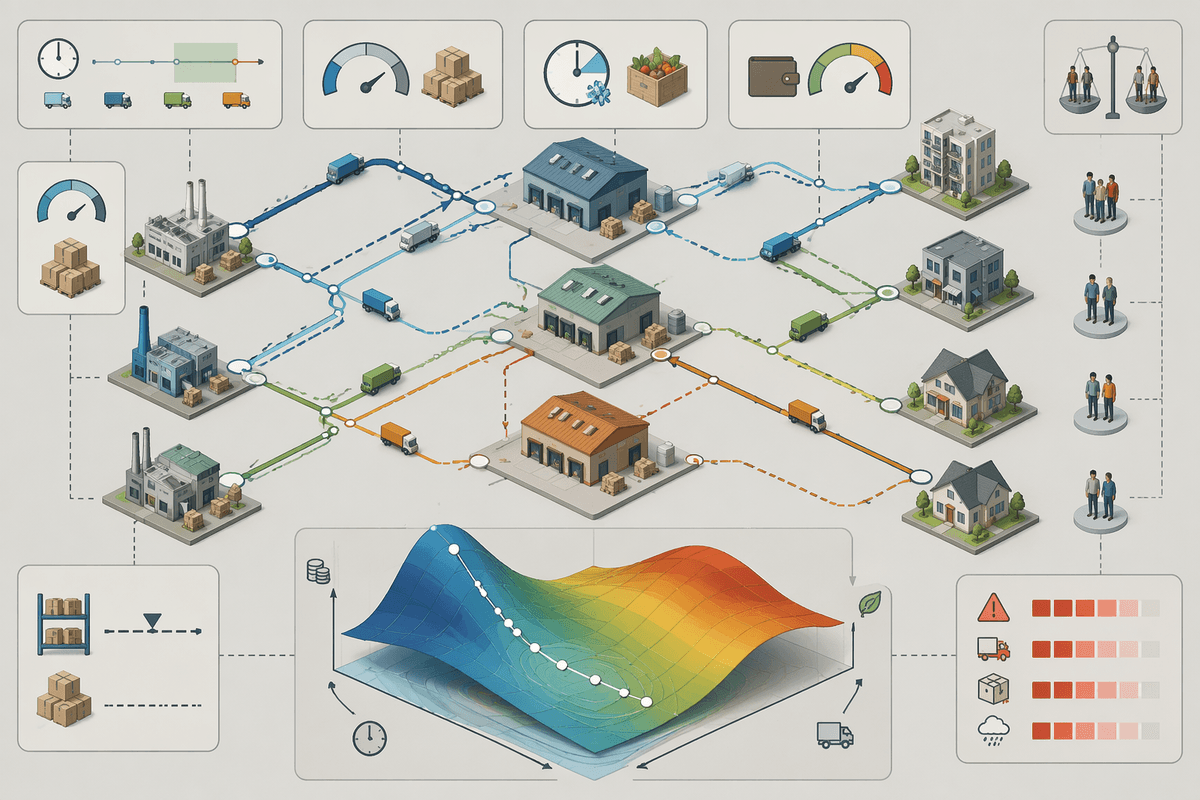
A familiar failure mode is treating planning like a model selection exercise before anyone agrees on what “good” means. Start by writing the decision in business terms: what action is being chosen, how often, and what metric will be judged. “Minimize total cost” is rarely specific enough; operations usually live in trade-offs like cost versus on-time delivery, margin versus fill rate, or throughput versus changeover time. Put those terms into the objective explicitly, including penalties for late orders, stockouts, overtime, churn risk, or contract breaches.
Then list constraints as rules the plan must satisfy, not as features to learn: dock hours, labor agreements, shelf-life, route feasibility, credit limits, safety stock floors, price bounds, and customer fairness policies. Constraints are where planning earns its keep, but they also drive implementation cost because each rule must be encoded, tested, and kept current.
Finally, choose the horizon that matches when commitments become expensive to undo. Too short and you optimize noise; too long and you pretend you can foresee supplier misses and demand swings. A practical default is a longer “look-ahead” with a shorter “lock-in” window you’re willing to execute, then replan on a cadence that matches how fast reality moves.
Choosing a world model: simulator, learned model, or hybrid
The common situation is having two “truths” in the organization: the ERP says what should happen, and the floor knows what actually happens. Your world model is the bridge between the two. A simulator is often the fastest way to start when rules are well understood—lead times, capacities, pick rates, carrier cutoffs—because it makes constraints explicit and lets you test counterfactuals (“what if we pull demand forward?”). Every process change, new lane, or policy exception becomes code you must keep current.
Learned models help where behavior is messy or hard to write down, like demand response to price, supplier reliability, or how congestion affects throughput. They can generalize, but they need representative history and careful monitoring for drift; if your last year didn’t include disruptions, the model may be confident in the wrong places.
Hybrids are common in practice: simulate the parts governed by rules, learn the uncertain pieces, and use the planner on top. The test is simple—can the model predict the outcomes you use to judge plans, at the cadence you need to replan, with errors small enough that constraints stay feasible?
Picking the planner: search, optimization, or receding-horizon control

A recognizable fork in the road is whether you’re choosing from a few discrete moves (“which load goes on which truck,” “which jobs run on which line”) or tuning continuous levers (“how much to order,” “what price to set”). Search-based planners fit the first case: they explore sequences of actions through a state space, often with heuristics to prune options. They’re intuitive and flexible, but branching explodes quickly, so you usually trade optimality for speed and need guardrails to avoid spending minutes to decide something that must run every five.
Optimization-based planners fit when constraints and costs can be written down cleanly—linear or mixed-integer programs for routing, scheduling, or replenishment. They can deliver strong results and clear constraint handling, but modeling is the work: encoding every exception, keeping coefficients current, and dealing with brittle feasibility when the real world violates assumptions (late inbound, missing scans, surprise downtime). Compute cost can also spike as you add integer decisions or longer horizons.
Receding-horizon control (often called MPC) is the pragmatic middle: plan with a longer look-ahead, execute only the near-term slice, then replan as new data arrives. It rarely gives a provable global optimum, but it’s often the best match for operations where uncertainty is constant and the main goal is staying feasible while improving key metrics over time.
Handling uncertainty: replanning, risk limits, and safety constraints
You’ve seen this in operations: the plan was “optimal” on Monday, and by Tuesday a supplier missed a date, demand shifted, or a line went down. The practical response isn’t to forecast perfectly; it’s to design the planner to absorb surprises. Replanning on a cadence—hourly for routing, daily for inventory, weekly for capacity—keeps decisions tied to what’s currently true. But replanning has a cost: more compute, more churn for teams executing the plan, and more opportunities for the system to “thrash” unless you add stability terms (for example, penalties for changing yesterday’s assignments without a material benefit).
Risk limits turn uncertainty into explicit policy. Instead of optimizing expected cost alone, you cap service-risk (“no more than X% probability of missing SLA”), budget worst-case exposure (“overtime spend not to exceed Y”), or enforce buffers (safety stock, time slack, reserve capacity). Safety constraints are the hard stop: never violate labor rules, temperature limits, credit holds, or fairness bounds, even if the model thinks it’s safe. In practice, teams start conservative, measure constraint violations and regret, then relax guardrails only where monitoring proves the system behaves reliably.
Making it work: evaluation, deployment patterns, and a starter checklist
The first pilot should look like an ops experiment, not a model bake-off: a clear baseline (current heuristic or dispatcher decisions), an offline replay or simulation on held-out weeks, then a limited “shadow mode” where the planner proposes actions without executing them. Measure both outcome metrics (cost, fill rate, on-time, throughput) and operational friction (override rate, plan churn, time-to-decision). Expect iteration: the fastest failures come from missing constraints, stale master data, or execution latency that makes “optimal” plans impossible to follow.
Deployment usually works best as a loop: ingest state, propose a plan, validate constraints, expose recommendations in the tools people already use, and replan on a fixed cadence with a lock-in window. A starter checklist: define objective weights and non-negotiable constraints; specify horizons and replan frequency; choose a world model you can maintain; log every state/action/outcome; add guardrails (risk caps, change penalties); create an override workflow; and set monitoring for feasibility, drift, and business KPIs before expanding scope.